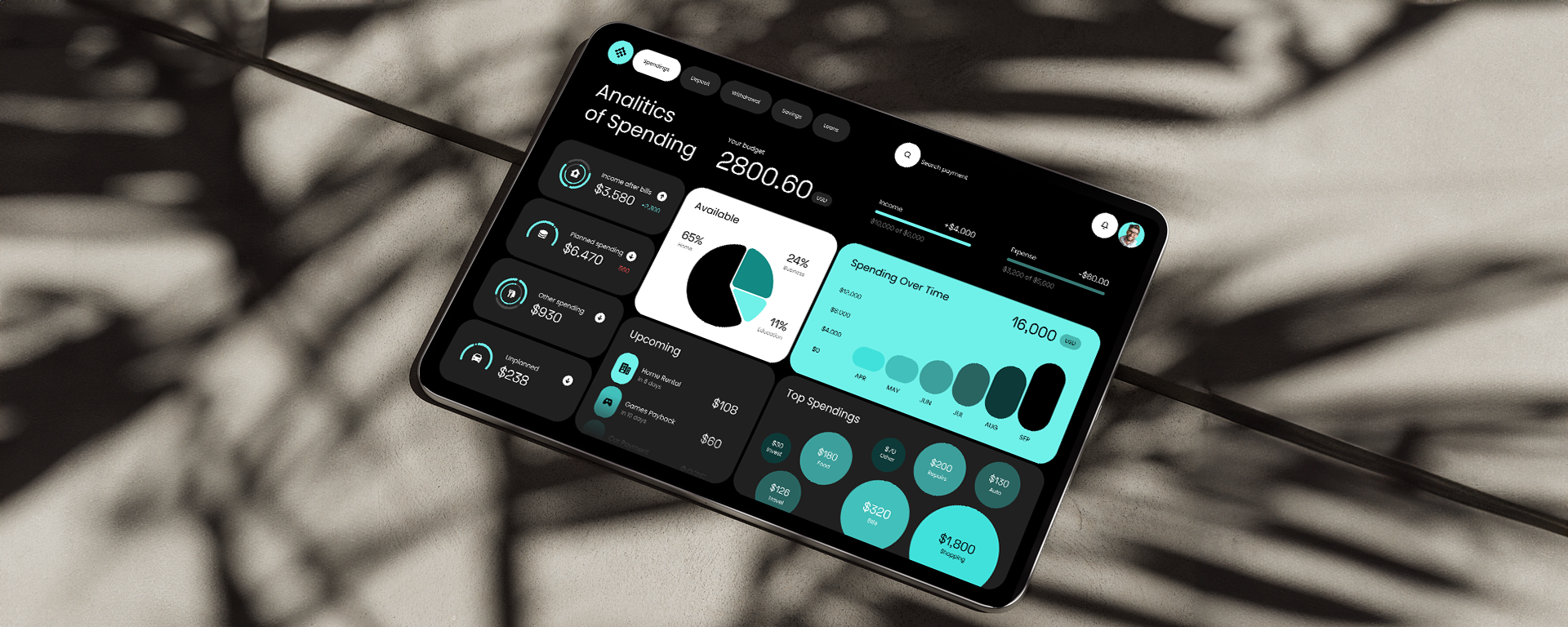
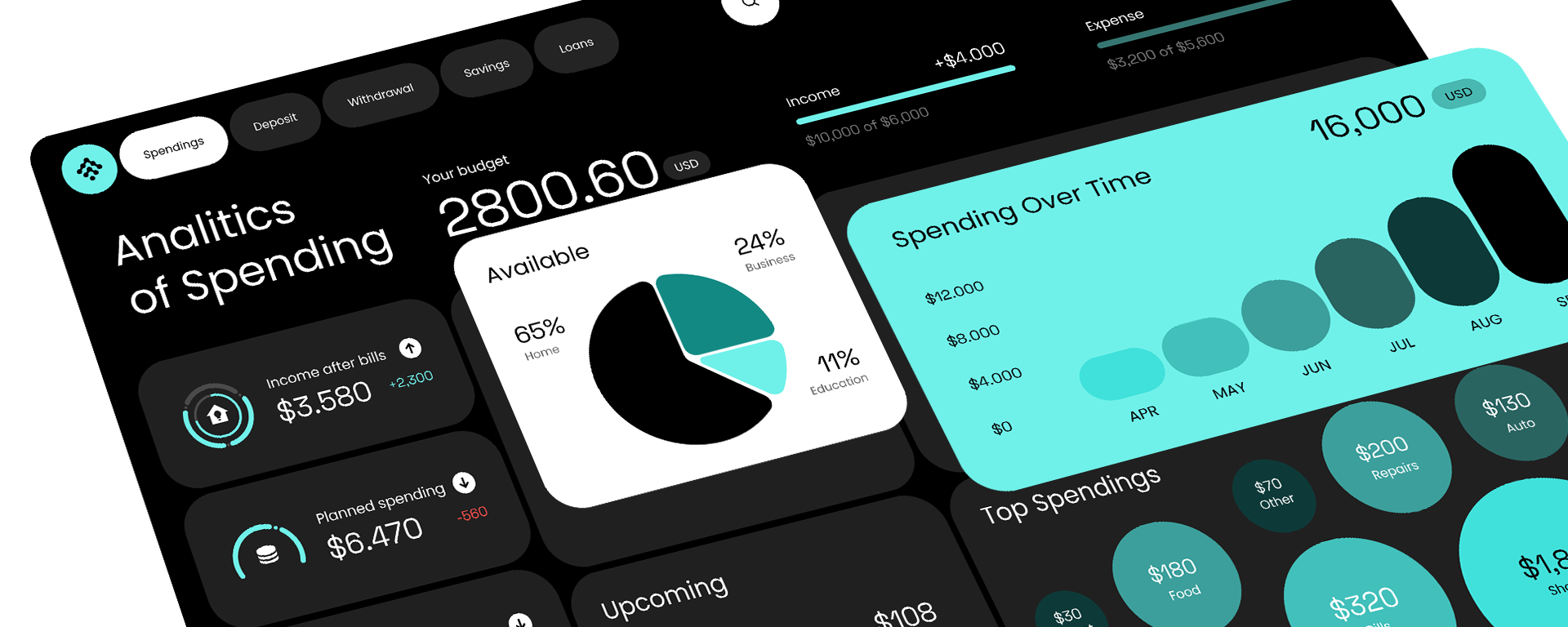
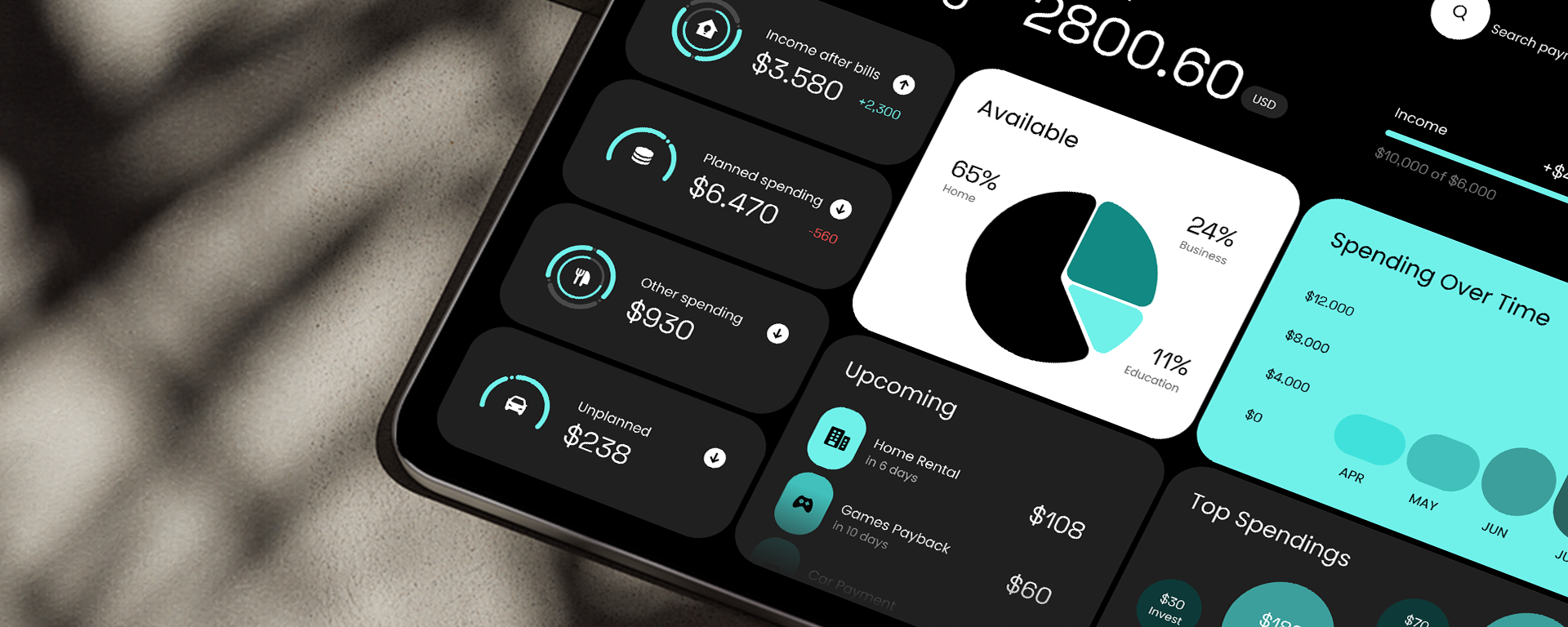
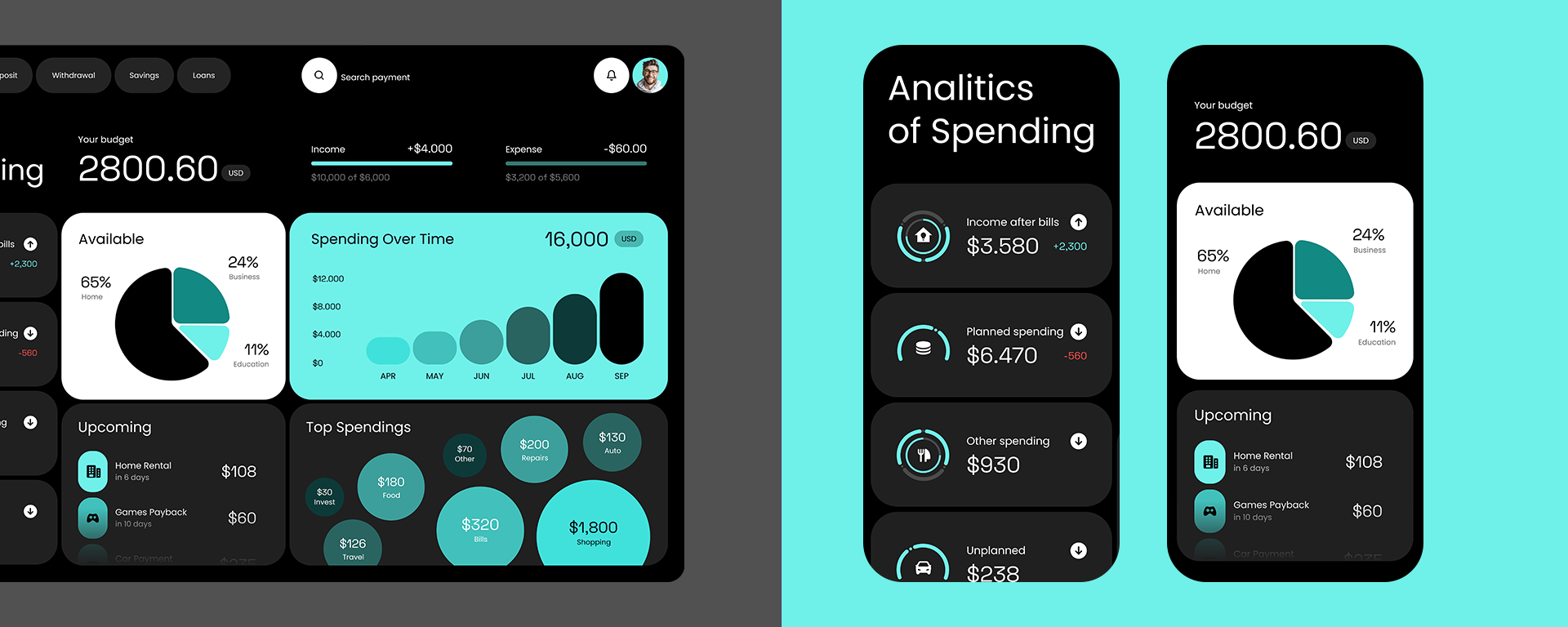
Designing a financial wellness platform that transforms raw financial data into clear, actionable decisions.
FinVue is a personal finance management app designed to help people save money and build wealth. The app allows users to link their bank accounts, credit cards, and other financial accounts in one place, giving them a comprehensive view of their finances.
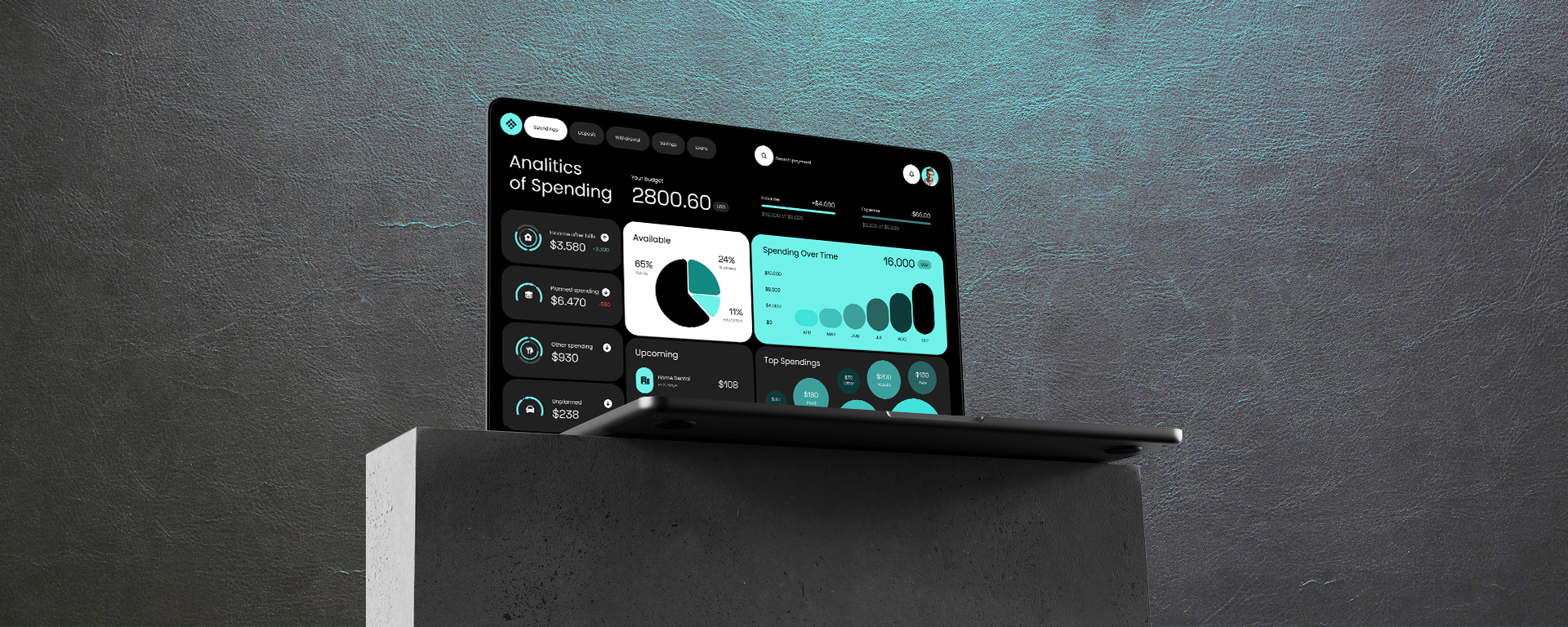
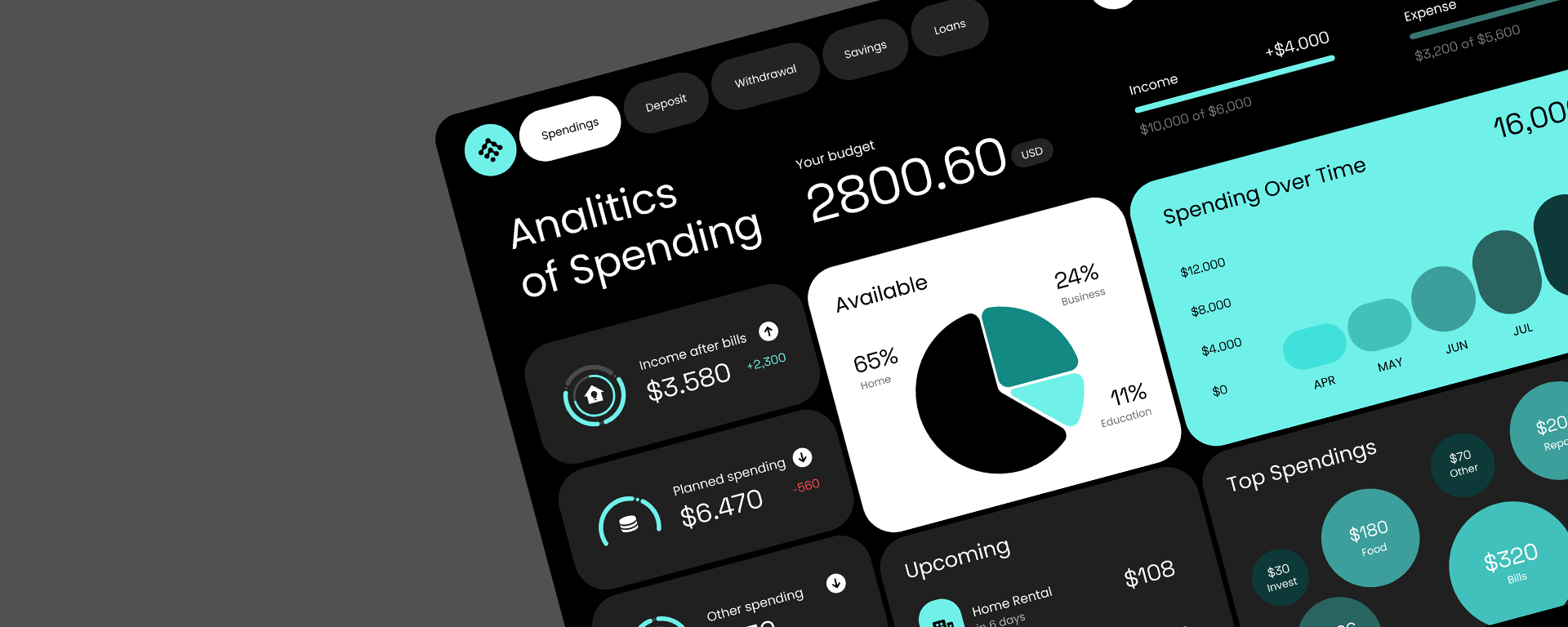
The refined dashboard transforms complex financial data into actionable insights. Quick-glance summaries, customizable widgets, and intuitive charts empower users to grasp their financial landscape effortlessly.
Most people’s financial life is scattered across multiple banks, credit cards, and investment accounts with no single place to see the full picture. That fragmentation makes it hard to answer basic questions (“Can I afford this?”, “Where is my money actually going?”, “Am I on track for my goals?”) without manually checking several apps.
.02 / The Solution
FinVue’s premise was to aggregate accounts into one dashboard but aggregation alone isn’t the hard part. The hard part is turning a wall of transaction data into something a non-financial-expert can actually act on, without dumbing it down to the point of being useless for people who do want depth (budgeting, investment tracking, spending-pattern analysis).
.03 / Research & Discovery
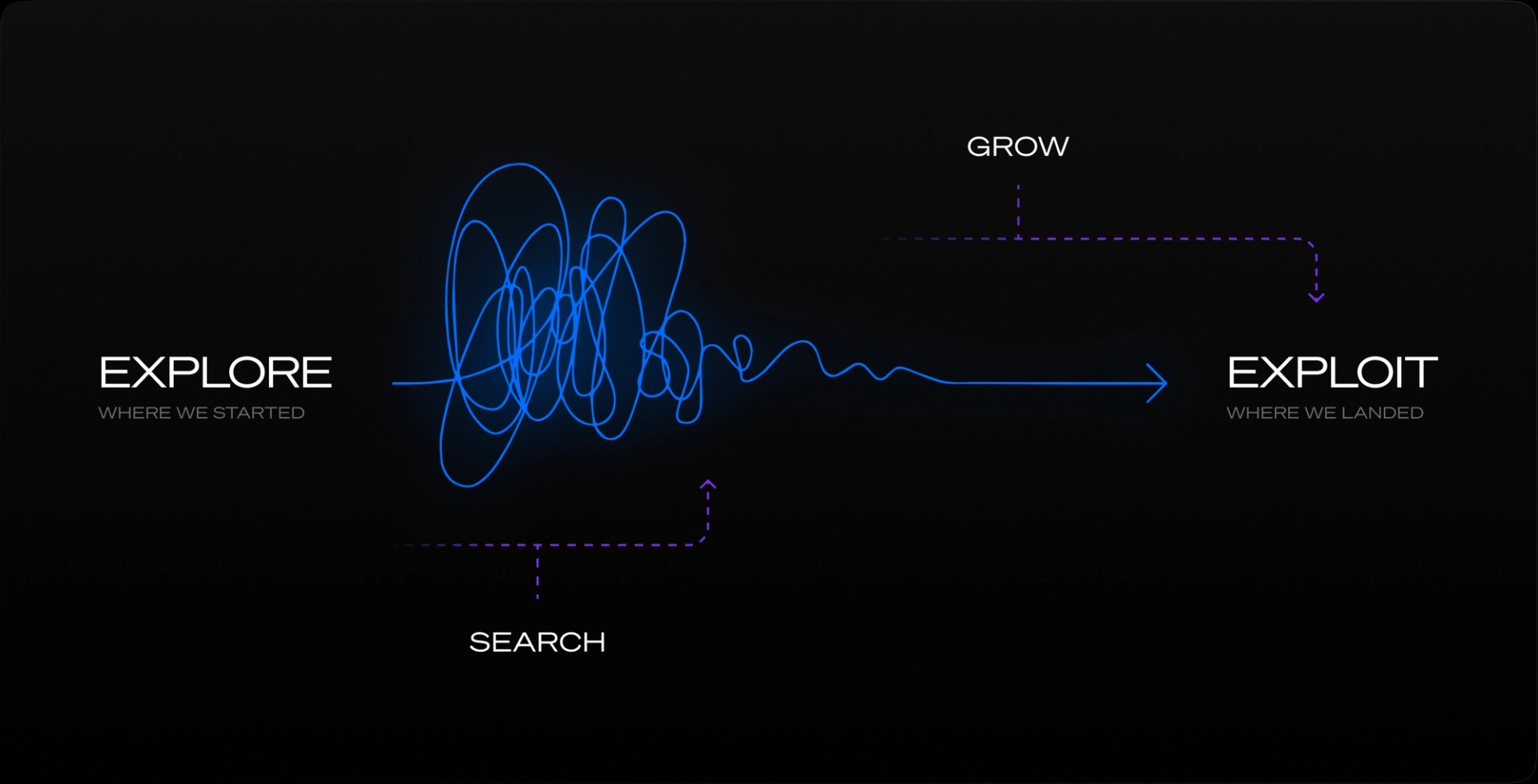
I looked at how existing finance apps (Mint, YNAB, Monzo) framed spending data, and where users commonly disengage. Usually when a dashboard shows raw numbers without any framing of whether that’s good or bad news.
Research Activities
Stakeholder workshops
Business requirement sessions
Product vision alignment
Feature prioritization workshops
Success metric definition
Interviews with individuals managing monthly budgets
Journey mapping exercises
Spending habit analysis
Financial goal identification
Interactive prototype testing
Internal design critiques
Product walkthroughs
Engineering feasibility reviews
Insight 1
Users don’t want more financial data.
They want confidence that they’re making the right financial decisions.
Insight 2
People naturally think about money in terms of goals not categories.
Insight 3
Financial health isn’t checked once a month.
Users make quick “micro-checks” several times throughout the week.
This influenced the dashboard hierarchy.
.04 / Mapping the core jobs, not just the screens
Before designing the dashboard, I identified the distinct jobs users needed the app to do: “tell me if I’m okay right now”,“help me stick to a budget”,“help me understand a pattern I didn’t notice” and “give me a report I can act on.” Each of those maps to a different part of the product. The at-a-glance dashboard, the budgeting module, the pattern/insights layer, and the reporting tools, rather than treating “show all the data” as a single undifferentiated goal.
.05 / Product Goals
The app’s sleek interface streamlines budgeting, expense tracking, and investment management for individuals and small businesses.
We defined five product goals:
01
Simplify personal finance management
02
Reduce financial anxiety
03
Help users build healthy financial habits
04
Surface actionable insights instead of raw numbers
05
Create a scalable design foundation for future financial services
.06 / Building the Design System
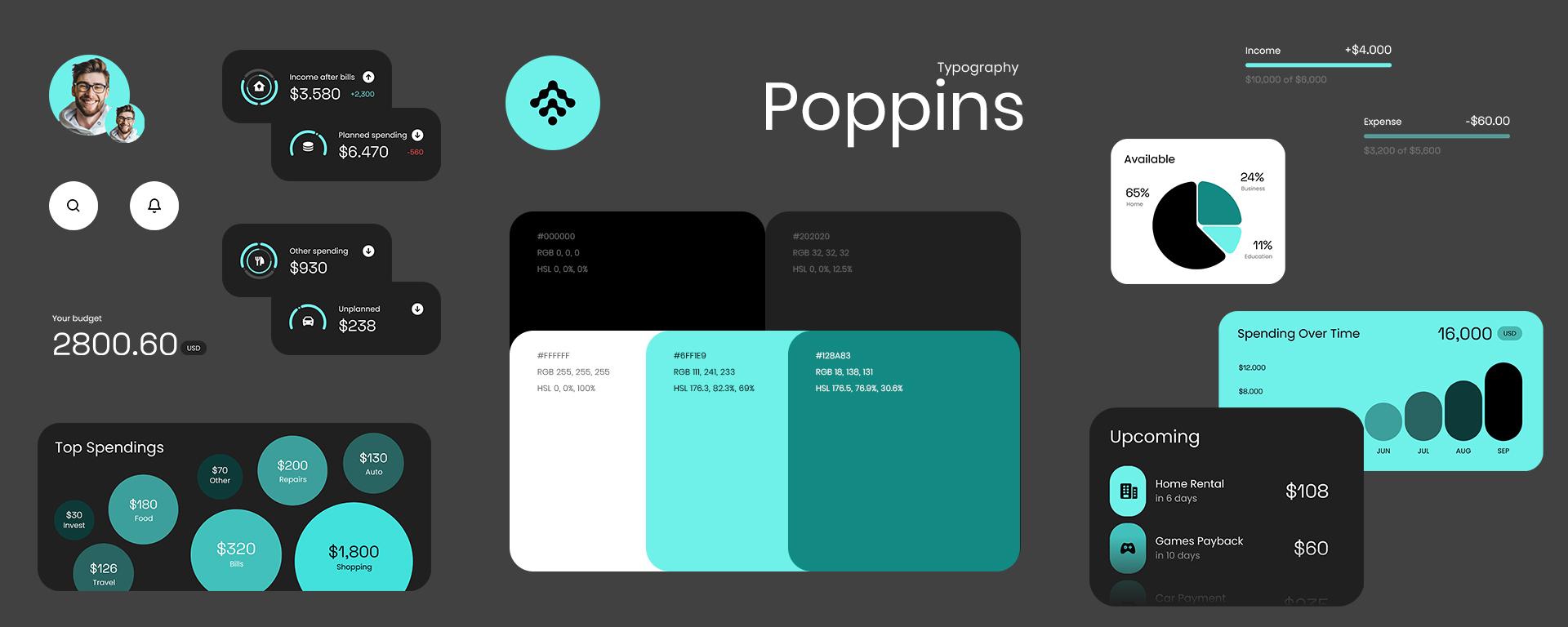
Rather than solving each module (dashboard, budgeting, reporting, insights) as a one-off, I built a shared component system. Chart components, budget-category cards, insight callouts, typography and color tokens so that a new feature like a spending-pattern module could reuse the same visual language as the dashboard instead of feeling bolted on.
.07 / Key decisions & Tradeoffs
01
I chose to lead the dashboard with a small set of framed insights rather than a full chart-heavy overview, trading some data density for faster comprehension since the biggest risk for a finance app is users disengaging before they find anything useful.
02
For the AI-driven budgeting suggestions, I designed them as dismissible, non-blocking recommendations rather than default actions users needed to stay in control of their own money, so the app suggests but never auto-applies changes
03
I designed explicit states for partial or failed account syncs, rather than assuming account-linking data would always arrive clean and complete, since a finance app silently showing stale balances is a trust-breaking failure
.08 / Platform Screens
From income-expense analytics to spending history reports, my FinVue redesign provides in-depth analyses to guide your financial strategies.
.09 / Smart Budgeting
AI-driven suggestions, real-time expense tracking, and goal-oriented budget categories ensure users stay on top of their financial goals effortlessly.
.10 / Personalized Insights
FinVue provides personalized insights and recommendations to help users make better financial decisions.
.11 / Outcome
Streamlined the trading workflow by consolidating key tools into one workspace
38%
increase in users who returned to check the dashboard within a week
90%
The design system shipped to production and was extended into the Mobile app, reusing 80% of core components without rework.
45%
After launching the new website, post-launch surveys show an NPS increase from +15 to +45.
.12 / Reflection
Designing FinVue reinforced an important lesson about personal finance products: people rarely need more financial data. They need more confidence.
Rather than optimizing for feature count, the project focused on helping users quickly understand their financial situation and identify the next best action. Looking back, I would invest even more time in validating long-term habit formation and experimenting with personalized financial coaching to encourage sustained engagement.
I am a Product Designer from Bulgaria with over two decades of experience, with a consistent focus on work that stands out. Built on human-centered methodology, rigorous craft, and a drive for outcomes that matter.